
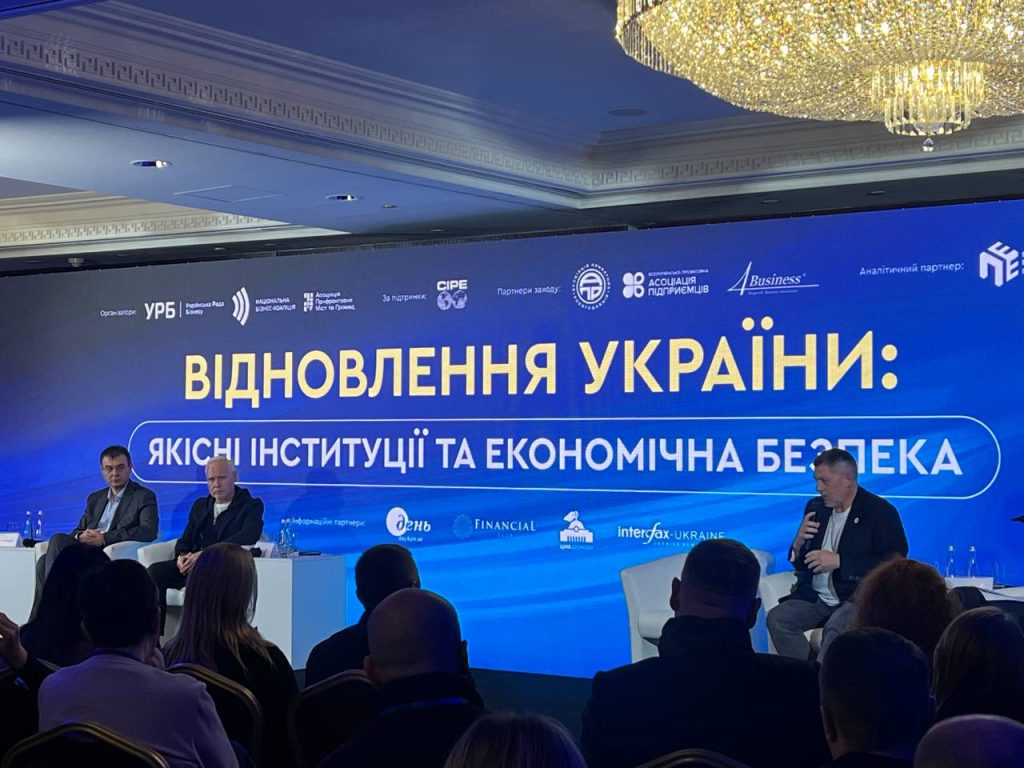
The Forum “Recovery of Ukraine: Quality Institutions and Economic Security” was held in Kyiv, uniting representatives from the Government, Parliament, local self-government, and the business community. Central topics included supporting the economy of frontline regions and the critical role of Small and Medium-sized Businesses (MSBs) in strengthening state resilience and progressing toward European integration.
MSBs — The Foundation of the Economy and Challenges to Reform
Forum participants underscored that MSBs are not only the basis of the consumer market and job creation but also a key driver of the country’s recovery and sustainable development.
Danylo Hetmantsev, Head of the VRU Committee on Finance, confirmed the political consensus on the necessity of preserving the Simplified Taxation System (STS) during the war:
“The Simplified Taxation System should not be touched at all until the end of the war.”
At the same time, he focused on a key problem—the abuses by large businesses that artificially break down into thousands of individual entrepreneurs (FOPs) to avoid paying VAT. It is these large-scale shadow schemes, particularly in the electronic cigarette, hotel, and restaurant sectors, that create pressure on the STS, distort competition, and form a significant part of the country’s 35% shadow economy.
Administrative Procedures and European Integration
A separate topic was the need to simplify administrative procedures, a critically important element of European integration. Local authorities emphasized the necessity of accelerating the connection of cogeneration and other energy facilities that can enhance the energy resilience of regions.
Frontline Regions — Ukraine’s “Security Belt”
Experts and local government representatives stressed that frontline regions are the “security belt” of Ukraine and Europe, and they must receive opportunities, not restrictions, for development.
Ihor Terekhov, Head of the Association of Frontline Cities and Communities, noted that frontline regions continue to work despite all the challenges of the war. He cited the example of Kharkiv, where over 127 thousand entrepreneurs are actively working today—more than before the full-scale invasion.
Key Business Demands and Government Solutions:
- Access to Finance Despite the resilience of local business, entrepreneurs in frontline territories receive only 13% of loans under the “5–7–9” program. Danylo Hetmantsev announced the implementation of portfolio guarantees for banks, which will allow lending to businesses even in high-risk zones.
- War Risk Insurance Minister of Economy Oleksiy Sobolev confirmed the launch of a state insurance program through the ECA (Export Credit Agency)—businesses will be able to receive compensation of up to 10 million UAH for damaged property.
- Special Economic Status for Frontline Territories Experts stressed the need to introduce tax incentives and the retention of Personal Income Tax (PIT) in local budgets to restore economic activity.
The Association highly commends the constructive dialogue and the participation of the business community in shaping the policies necessary for the country’s recovery. We emphasize the vital role of the fuel industry’s MSBs, which ensure the energy and economic resilience of Ukraine, especially in the frontline regions.
FEBA Calls on the Government and Parliament:
🔹 Focus on combating the shadow and counterfeit market, which creates systemic distortions and undermines budget formation, rather than increasing regulatory pressure on legal businesses.
🔹 Immediately implement the promised support tools for frontline territories, specifically:
- Portfolio guarantees for banks;
- State insurance of war risks through the ECA.
These tools are necessary conditions for unblocking lending, attracting investment, and restoring economic activity.
We hope that the Forum’s Resolution will become the foundation for decisions that will strengthen the economy, ensure energy resilience, and help Ukraine move along the path of recovery and integration into the European economic space.